
Three Questions for a Meeting Going Nowhere
Originally published in our newsletter.
It was one of those meetings. We were supposed to be figuring out what to do about an initiative that had gone off track. The debate had been going in circles with no signs of stopping. I glanced at the clock. We were already over time. I sent a message to the chat: “Sorry! Gotta drop.” I didn’t even have another meeting; I just couldn’t take it anymore. We weren’t getting anywhere.
Sound familiar?
It took me a while to put my finger on why the conversation was so unproductive, but once I did it seemed so simple. We’d skipped the basics. We hadn’t agreed on what we were trying to accomplish, and we didn’t have the same perspective on the current situation. That meant everyone had come in with their own ideas for how to get things back on track, but no one agreed on what “on track” actually meant in this context.
We needed to answer three foundational questions.
Where are we trying to go? We had goals for the initiative, but things weren’t going to plan. Something had to give. So what did we want to prioritize? Was it more important to deliver all the promised capabilities? Adhere to the schedule? Ensure that we were setting ourselves up for success for future deliveries? Stick to the process we had agreed on? The conversation would have been more productive if we had centered it on the outcomes we wanted.
Where are we now? Everyone had their own perspective on the current situation and instead of sharing information, people were pointing fingers.
You’re moving too slow.
You gave us unclear requirements.
That is an excuse.
The points people were raising reflected their judgments and conclusions, not the raw data they were drawing on. What was completed so far? What had we learned? Where were the remaining hurdles? We needed a shared, objective view of the situation based on empirical evidence, not opinions. We needed to see the same reality.
What are all the ways we can get from here to there? Our circular debates stemmed from circular thinking. Problem: we lack clear requirements. Solution: get clearer requirements. Even if we had clearer requirements, we couldn’t deliver the initiative according to the original plan. Instead of getting locked into position-based arguments, we needed to explore all the paths from where we were to where we wanted to be.
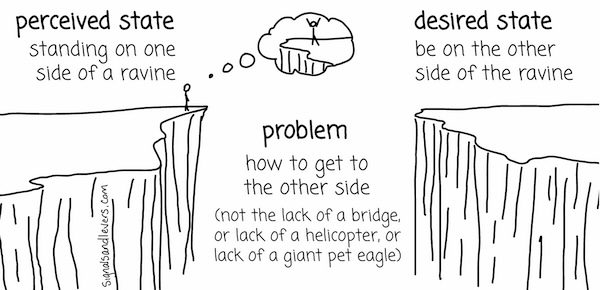
A cartoon from Chapter 11 of Signals & Levers that illustrates the difference between problems and solutions.
If we’d been seeing the same reality and agreed on where we wanted to go, we could have treated all the ideas about how to get there as hypotheses. We didn’t have to agree on one approach. We could have tried several, and we could have treated each one as a small experiment. That reframe is the essence of what Signals & Levers Chapter 11, “Hypotheses in Change,” is all about.
So the next time you’re trapped in a meeting that’s going nowhere, consider asking the three questions: Where are we trying to go? Where are we now? What are all the ways we can get from here to there? That might just be enough to cut through the circular debates and lead to a productive discussion.